
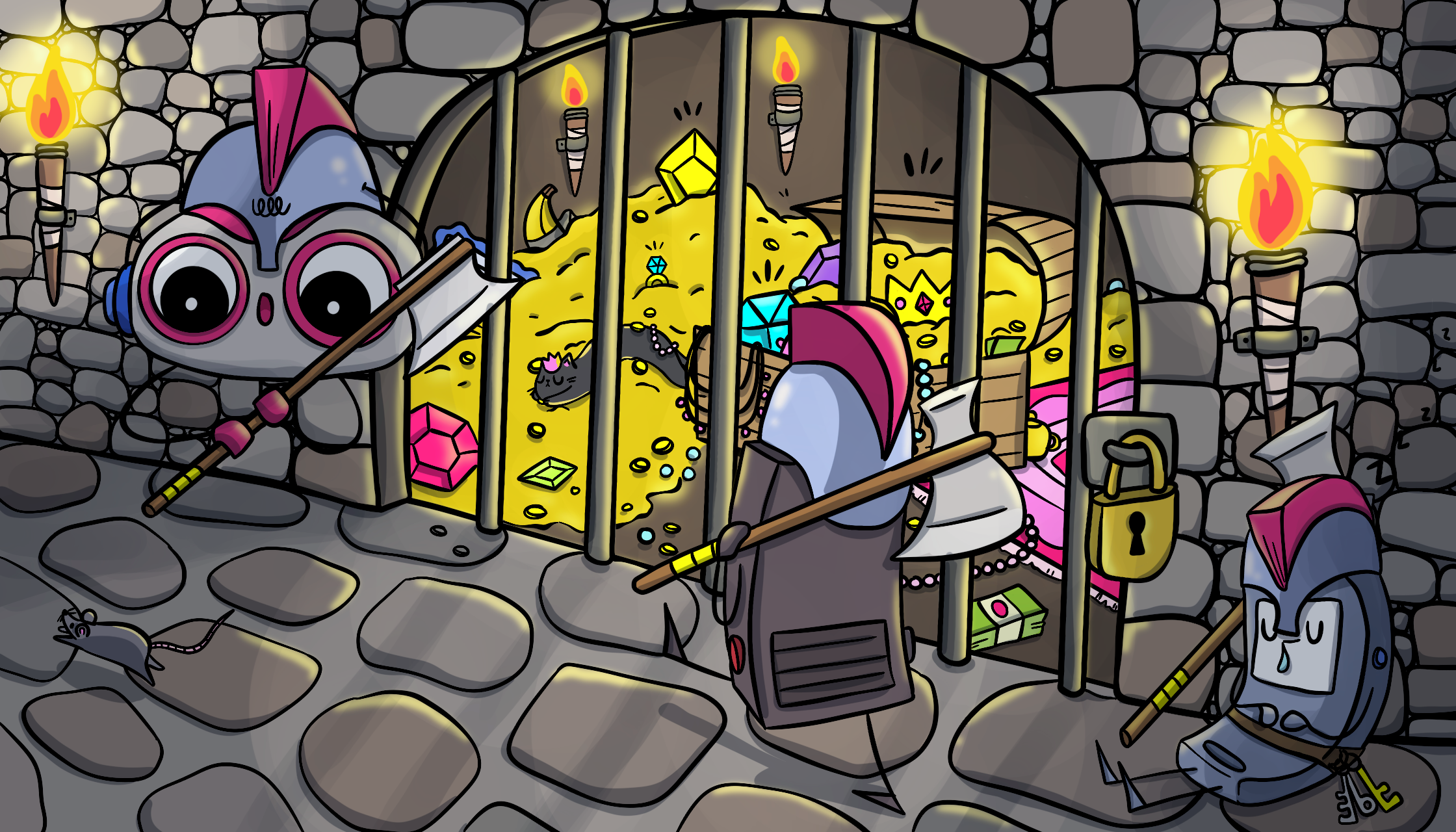
 CLICK HERE TO DOWNLOAD THIS IMAGE & COLOR IT IN!
Member trust is the ultimate crown jewel for credit unions, and cybersecurity plays a critical role in protecting that trust. When a breach occurs, the greatest loss isn't the loot taken from the vault. The real damage comes in the form of a strained relationship between the institution and the members it serves.
Envision yourself descending beneath a castle by torchlight. You arrive at a massive iron door, and behind it lies the kingdom's treasure hoard. The vault is protected by thick stone walls, reinforced gates, and vigilant guards standing watch. At a glance, it seems impenetrable.
Then the alarm bell sounds. Suddenly, even the strongest security measures matter far less than the actions of the people protecting the vault. Does anyone know how the thieves entered? Who alerts the council? How can the narrative be controlled when uncertainty begins to spread faster than facts?
A real cyber incident unfolds the same way. And in the case of cybersecurity for credit unions, maintaining member trust depends on whether the people leading the defense know how to respond when the enemy is at the gate. Cybersecurity tabletop exercises serve as a direct method for levelling up incident response skills, and therefore a direct method for stewarding member trust. Read on to discover how credit unions can employ continuous TTX to build a legendary incident response program that moves beyond compliance-driven exercises, develops high-caliber IR reflexes, and identifies gaps to close as the threat landscape evolves.
In the modern era, cybersecurity tabletop exercises are often associated with compliance, examinations, and NCUA expectations. But they weren't originally crafted to satisfy audit guilds. They were forged to sharpen incident response and bolster overall cyber resilience. So why are TTXs now oftentimes viewed as an annual box-checking ritual? Discovering the answer requires a short history lesson.
Let’s turn the pages back two decades, to the dawn of cybersecurity regulations for financial institutions. In those early days, regulators simply required that guards were posted and security measures were in place, seldom questioning whether either could withstand a true siege. Then came the great regulatory scrolls, first the Gramm-Leach-Bliley Act (GLBA), followed by the guidance of the FFIEC. It was with their passing that financial institutions were increasingly expected to craft information security programs, incident response plans, and methods for testing them. As the years passed, new instruments were placed into the hands of the inspectors. Chief among them was the FFIEC's Cybersecurity Assessment Tool (CAT, which has since been replaced by the NIST framework). This tool reinforced cybersecurity expectations and gave examiners a structured way to inspect the realm’s defenses.
While these regulatory updates were noble at heart, they caused TTXs to gradually become associated with scribes, ledgers, and compliance, rather than a proving ground for testing cyber resilience. Thus, the compliance checkbox problem was born.
The credit union realm changed in 2023 when the NCUA implemented its 72-hour cyber incident reporting requirement. A countdown clock would now be summoned whenever the alarm bell rang. No longer was it enough to simply ask whether the kingdom possessed a battle plan. Instead, the question became “ can our defenders could recognize the attack, rally the realm, and fulfill obligations before the sands of the 72-hourglass are spent?”
In 2024, another regulatory scroll (NCUA Letter 24-CU-02) was conjured to elevate the importance of preparedness by explicitly directing credit union boards to conduct regular tabletop exercises. What began as a best-practice recommendation had transmogrified into a mandatory, board-level expectation with measurable consequences.
Though the laws of the land have changed, old habits still linger. Many credit unions still regard the tabletop exercise as a yearly obligation rather than a consistent method for bolstering the kingdom's defenses.
And therein lies the danger. Sure, the guards may have attended their annual training. The report was archived and sealed away. The box was checked.
However, the enemies beyond the walls do not measure their ambitions by the calendar. Cyber resilience isn't built through a single day of practice. It is steeled through repetition.
The strongest kingdoms return to the training grounds again and again. With each gathering, hidden weaknesses are brought into the torchlight. When the alarm bell finally rings, a well-practiced credit union stands ready not because a box was checked, but because the lessons of many seasons have been hardened into instinct.
The most valuable moments in a tabletop exercise occur when the heroes gathered around the war table come to a disagreement. An IT captain believes the gates should be sealed. The leader of the PR guild argues for informing the townsfolk immediately. An Operations messenger reveals that nobody knows who carries the authority to make the final call. To some, such moments appear troublesome. To a wise Facilitator, they are treasure.
Cyber incidents are rarely won through technical accuracy alone. Victory comes through effective communication, coordination, and human decision-making under pressure. TTXs are meant to test and strengthen each of these skills.
Over time, improvements in these disciplines become the true measure of preparedness. For credit unions, every lesson learned and every gap closed strengthens the kingdom's ability to protect what it holds most dear: member trust.
Threat actors do not pause their campaigns while organizations await the next annual tabletop exercise. While guards review old battle plans, new threats gather beyond the horizon and probe the kingdom's defenses in unexpected ways.
A glance across today's threat landscape reveals what credit unions and financial institutions are up against:
In the growing shadow of these threats, the most resilient credit unions understand that a blade drawn once per year loses its edge. Rather than relying exclusively on one grand annual exercise, they return to the war table consistently throughout the year.
Sometimes the gathering is vast, bringing leaders from across the realm together to navigate a complex scenario. Other times, a small council from one department assembles around a single threat. Shorter, focused conversations help transform incident response from a document into a discipline. Combined with occasional organization-wide exercises, this approach reduces fatigue while steadily strengthening cyber resilience.
At the beginning of this tale, we designated member trust as the crown jewel for credit unions. In order to defend this crown jewel, a credit union’s incident response team needs to have high defense skills. The strongest cybersecurity tabletop exercises build those skills by drawing participants into the story and giving them a reason to care.
The most engaging stories have a curious kind of magic, where the lessons meant for the hero are meant for us as well. The same applies to a good TTX, which allows party members to find a piece of themselves within the story. So how can Facilitators achieve this?
First, it's critical that the scenario be realistic and grounded, rather than overly dramatic. A dragon crashing through the castle gates may be an exciting tale, but few around the war table will see themselves in it. A trusted software merchant whose wares have been quietly poisoned, however, is another matter entirely.

Next, infuse the TTX with an essence of familiarity, without getting overly personal. For example, you could follow the story of a fictional credit union that relies on a trusted third-party tradesman to process member transactions. Maybe one inject finds the marketing guild preparing a statement while footsoldiers from Operations are still working to understand what happened. Though the names, faces, and places belong to fiction, the circumstances should feel strikingly familiar to those gathered around the table.
This subtle layer of separation empowers party members to speak more freely. Instead of falling under a spell of paranoia and wondering whether the story is secretly about them or their department, they can focus on the choices before them. And if any party members begin to grow agitated, remind them of their duty to uphold the security of the credit union’s members.
The most effective Facilitators also understand that the best stories do not travel in a straight line. Just as the old bards wrapped their lessons in twists and uncertainty, a well-crafted tabletop scenario should occasionally obscure the path ahead.
Try including one of these in the next TTX you run for a credit union:
These moments are not obstacles to the exercise. They are the exercise. Completing challenges like these can unlock epic incident response abilities.
When cyber bandits come pounding at the door, the first signs of trouble may appear within IT. But the effects rarely stay there. Before long, you may find the member services guild fielding anxious questions from the townsfolk while risk and compliance archivists begin consulting the ancient regulatory scrolls. Due to the cascading nature of cyber incidents, kingdoms cannot protect crown jewels with IT guards alone.

The strongest credit unions recognize that defending member trust is not the responsibility of a single department, but a shared charge carried by the entire realm. Each party member’s position brings a unique perspective on what it it takes to maintain member trust. By bringing leaders from across the credit union together around the war table for incident response drills, Facilitators help forge IR programs built to last.
The tale does not end at the conclusion of an exercise. For credit unions, this is where cyber resilience truly takes shape. A TTX may reveal the path forward, but only thoughtful action and steady follow-through can transform those discoveries into lasting protection for member trust.
Whether it’s a hidden tunnel beneath the castle that must be sealed, or a watchtower that needs to be raised before the enemy returns, the discoveries made during a tabletop exercise make no difference if they go unaddressed. If these lessons are left without an owner or a clear timeline, they have a habit of resurfacing at the next gathering around the war table, or worse, during a real cyber incident.
The strongest credit unions ensure that every gap uncovered has a champion responsible for sealing it, a realistic path to completion, and leadership committed to seeing the work through. That is how the weaknesses of one quest become the strengths of the next.
Not every kingdom begins with towering walls and an army of seasoned knights. Rome wasn’t built in a day, and neither are great cybersecurity programs.
The temptation after a tabletop exercise is to rebuild the entire castle at once, but that’s the type of challenge that leads to burnout and abandonment. Instead, select one or a few manageable gaps to address. The victory condition here is forward momentum, whether marginal or massive in scale. Over time, these steady improvements accumulate into a stronger incident response program without overwhelming the laborers responsible for carrying the work forward.
Then, return to the TTX table. A well-crafted tabletop exercise provides the perfect opportunity to test the changes a credit union has made, uncover the next opportunity for growth, and continue the cycle. In this way, cybersecurity tabletop exercises become more than isolated events. They become an ongoing conversation about how to better defend the kingdom, and the trust of those it serves.
The curious thing about cybersecurity tabletop exercises is that the best way to satisfy compliance is to stop treating them as compliance. The most well-prepared credit unions understand that no report tome, no attendance ledger, and no archived document can prepare a them for the moment the NCUA's 72-hour clock begins to tick.
A well-run TTX will always support regulatory expectations, but cyber resilience cannot simply be written into existence. It is built through action. Over time, the steady improvements spawned from tabletop exercises will become the confidence a credit union needs to protect its members when an adversary threatens the realm.
One of the best ways a credit union can protect its members and preserve their trust in the modern age is by maintaining a well-trained incident response team and a well-tested IR plan. Cybersecurity tabletop exercises are a tried-and-true way to sharpen these skills and strengthen cyber resilience across any financial institution.
A cybersecurity tabletop exercise (TTX) is a discussion-based simulation that allows teams to practice responding to realistic cyber incidents in a safe, low-risk environment. For credit unions, tabletop exercises help strengthen incident response capabilities, improve cross-functional coordination, and build the cyber resilience needed to protect member trust.
While federal regulations do not prescribe a specific tabletop exercise schedule, NCUA guidance increasingly emphasizes the importance of regular cyber incident simulations. NCUA Letter 24-CU-02 specifically encourages boards to ensure that their credit unions conduct tabletop exercises, making them an important component of modern cybersecurity governance and preparedness.
Many credit unions meet baseline expectations by conducting one tabletop exercise each year, but organizations seeking stronger cyber resilience often practice more frequently. Smaller, focused exercises throughout the year help teams improve incident response skills, validate improvements to their plans, and adapt to an evolving threat landscape.
Cyber incidents rarely stay contained within IT. Effective tabletop exercises should include executive leadership, operations, member-facing teams, risk and compliance, communications, legal, and any other stakeholders who would play a role during a real incident. Bringing these groups together before the alarm bell rings helps credit unions improve coordination, communication, and overall preparedness.
Credit unions are stewards of information that’s highly-coveted by cyber bandits. Building incident response programs capable of warding off these attackers can be difficult, but you don’t have to do it alone. Ally exists to help Facilitators run exercises that earn trust, drive engagement, and surface what truly needs to be addressed.
Our Build tool shrinks the hours-long scenario creation process into a trial that takes just a few moments. Once you’ve drafted your quest, ditch PowerPoint and use the Run tool to help with delivery. Featuring anonymous Party Voting and a dynamic impact score based on customizable Impact Metrics, this tool puts the power in the hands of the Facilitator in both online and in-person sessions. Once the dust settles, an After-Action Report is conjured for executives within minutes.
If you’re ready to bring a new level of clarity and engagement to your TTXs, then your next quest is simple. Book a demo, and let’s chat about how we can empower your next campaign.



About Ally Security
Ally is here to support facilitators, which in turn creates a virtuous cycle where exercises take less time, provide more value, are run more frequently, and can make every organization can be better prepared.
The unexpected wins. The client curveballs. The chaos you couldn’t have scripted if you tried. Dear Asa is your space to share the stories that don’t make it into the official post-incident report. Script, submit, and enjoy a chance to be featured or quoted in an upcoming post.


